



By the time someone feels "too hot," their core body temperature is already elevated. Heat illness builds silently — and the people who feel it last are the ones most at risk: children, athletes, outdoor workers, and anyone who hasn't acclimatized to the conditions.
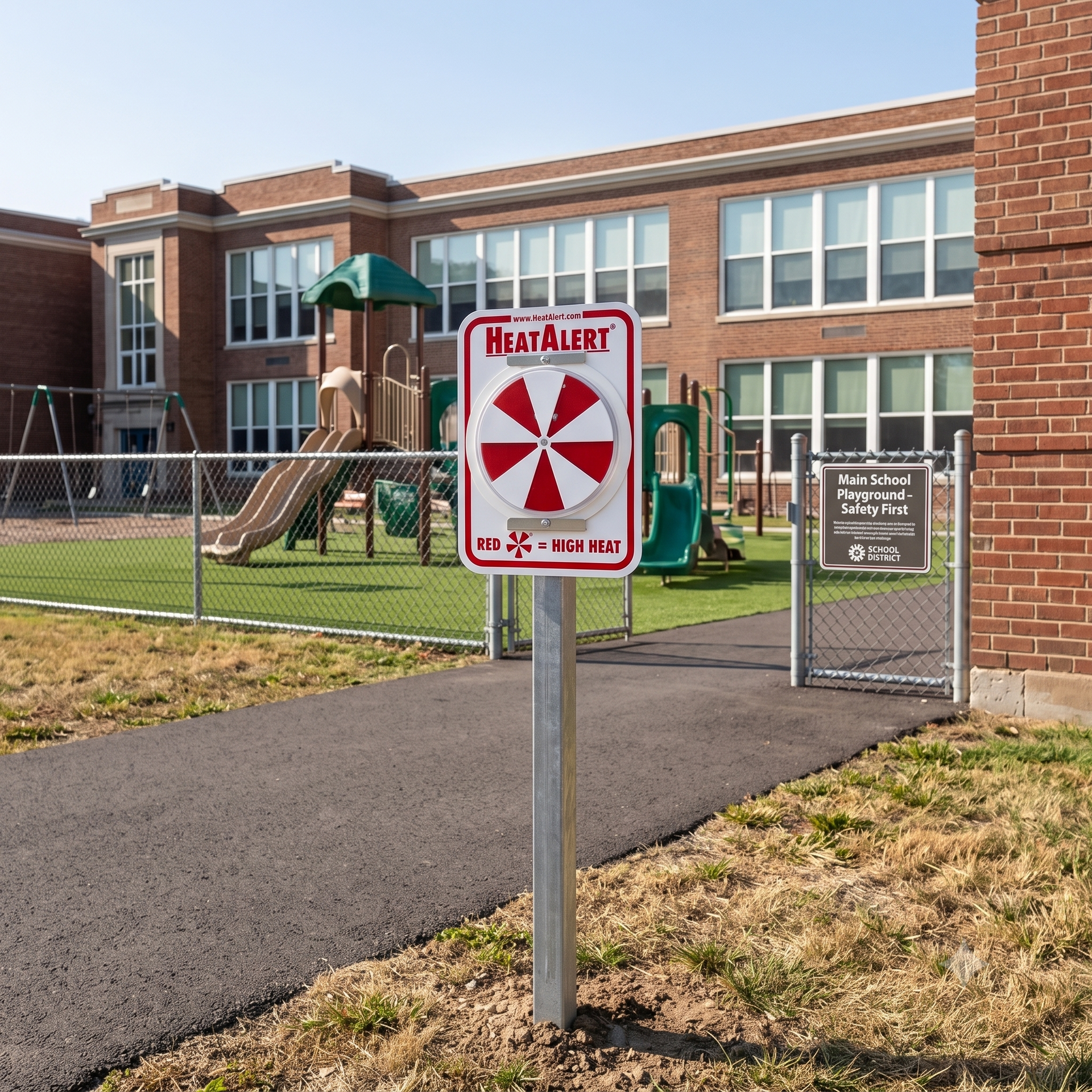
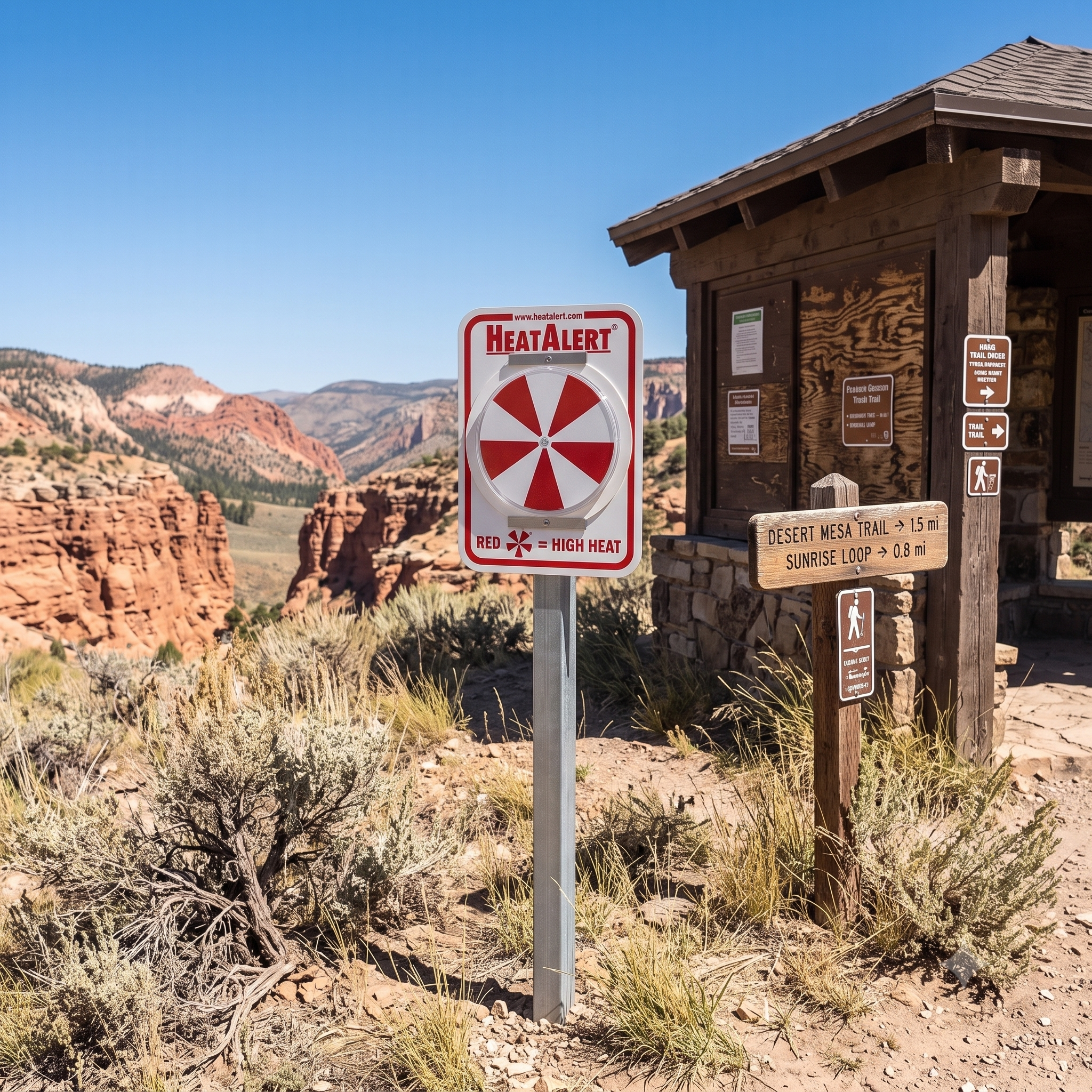
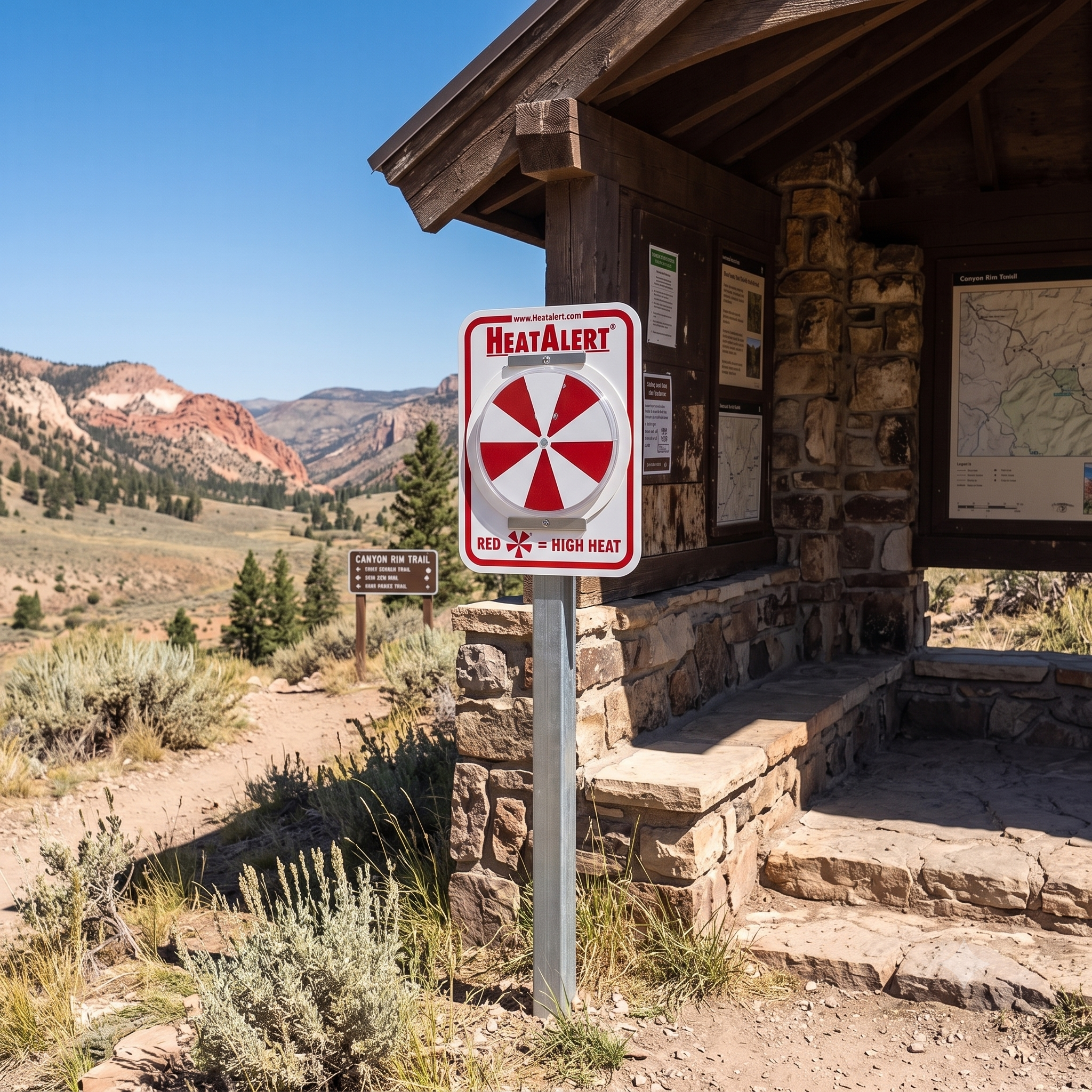
HeatAlert sits where people transition into the heat. Building exits, field gates, loading dock doors, playground entries, walkway crossings. When the disc turns red, every person walking past sees the same warning at the same moment — no app, no announcement, no judgment call.
That's the same passive, install-and-forget approach IceAlert® has used to protect people from ice for 27 years. Now calibrated for the other end of the thermometer.
How HEATALERT works
One bimetallic disc. Three states. Zero maintenance.
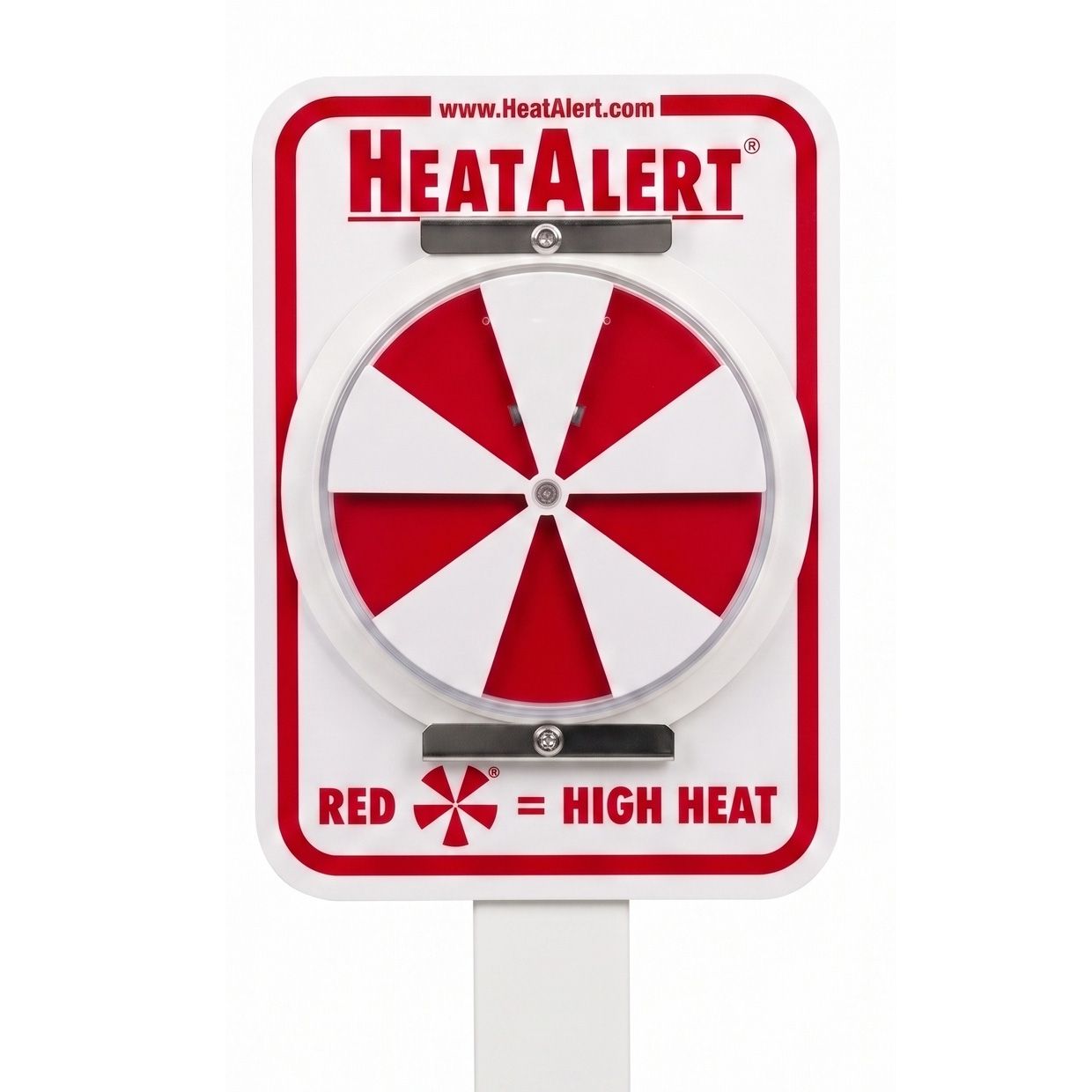
HeatAlert uses the same proven bimetallic mechanism as IceAlert — just calibrated for heat instead of cold. The disc physically rotates in response to ambient temperature, revealing more red as conditions get hotter.
1
Below 85°F — White
The disc holds in its safe position. Mostly white with the IceAlert logo visible at the center. Conditions are within normal range for outdoor activity.
2
86°F → 92°F - Rotating
As ambient temperature crosses 85°F, the bimetallic spring begins to rotate the disc. Red wedges become progressively more visible, signaling that conditions are warming toward the threshold.
3
92°F+ - Fully Red
At 92°F the disc has fully rotated to its red position. The pinwheel is solid red and the bottom of the sign clearly reads RED = EXTREME HEAT. Heat protocols should be in effect.
A passive visual air temperature warning
- An always-on visual cue that ambient air temperature has crossed 86°F → 92°F
- A prompt for teachers, coaches, supervisors, and staff to check actual heat conditions and act
- A consistent, mechanical signal that doesn't require batteries, software, or a person to read a number
- A complement to heat index apps, WBGT meters, and continuous monitoring like HeatAlert Connect™
- A research-anchored screening tool for the temperature at which less-acclimatized people (children, athletes, new workers) begin facing real risk
A measurement of perceived heat or compliance metric
- A heat index reading — it cannot account for humidity, which dramatically changes how hot conditions feel
- A WBGT measurement — the OSHA-recommended workplace metric that incorporates humidity, radiant heat, and air movement
- A substitute for OSHA-required workplace heat monitoring under federal or state heat illness prevention rules
- An indicator of safe conditions when the disc is white — high humidity or direct sun can produce dangerous heat index values below 84°F
- A standalone go/no-go decision tool for outdoor activity, athletic practice, or work continuation
Use HeatAlert alongside the right measurement tool for your situation.
HeatAlert's job is to be the visible warning at the doorway. The decision about whether to send kids outside, continue football practice, or pull workers off a roof should be made with a metric appropriate for your environment — heat index, WBGT, or continuous monitoring.
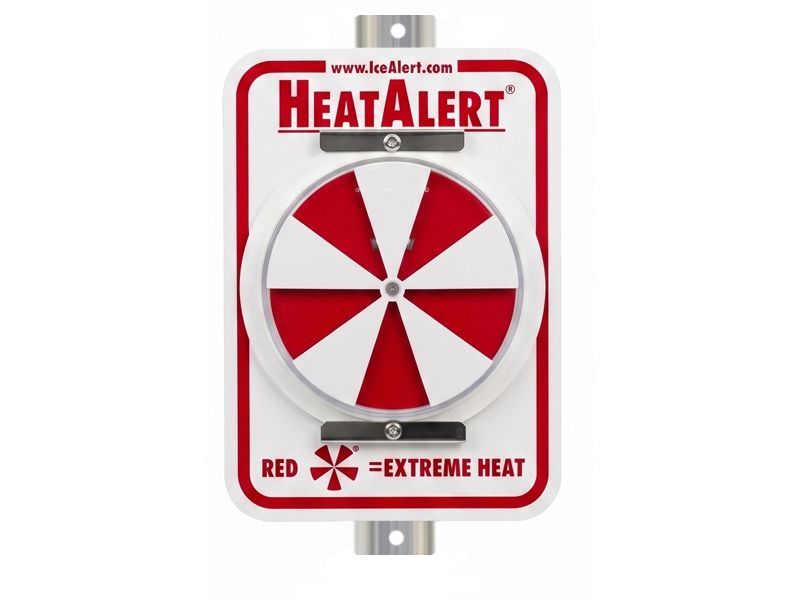
HeatAlert™ Universal Mount
- ✓ 7″ × 10″ aluminum sign with 6″ bimetallic disc
- ✓ Mounts to any vertical pole, post, column, fence, or wall
- ✓ Stainless steel mounting brackets included
- ✓ Disc begins rotating at 86°F, fully red by 92°F
- ✓ 2-year warranty, 7+ year service life
- ✓ Ships in 1–2 business days from Lake Oswego, Oregon
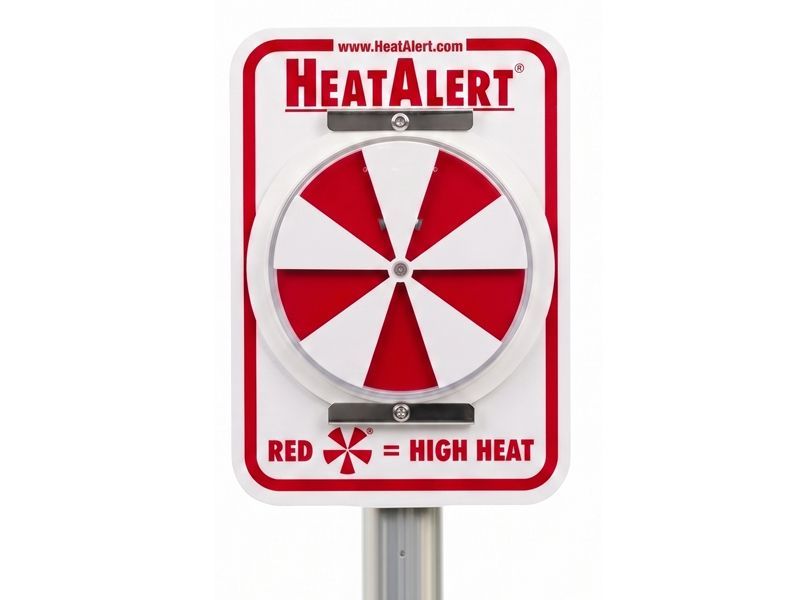
HeatAlert™ Post Mount
- ✓ 7″ × 10″ aluminum sign with 6″ bimetallic disc
- ✓ Pre-mounted on 6ft aluminum C-channel post — 100% rust-proof
- ✓ Anti-theft assembly — no separate mounting required
- ✓ Disc begins rotating at 86°F, fully red by 92°F
- ✓ 2-year warranty, 7+ year service life
- ✓ Ships in 1–2 business days from Lake Oswego, Oregon
Building exits
At every door leading from a climate-controlled space to outdoor walkways, parking, or work areas.
Loading docks
Where workers transition from cool warehouses into direct sun and outdoor humidity.
Outdoor work areas
Construction zones, agricultural fields, utility sites, equipment yards, and outdoor staging.
Athletic facilities
Field entrances, track gates, stadium concourses, and practice facility doors.
Playgrounds & recess
At every gate or doorway leading from a school or daycare building to outdoor play areas.
Bus loops & pickup zones
Where people wait outdoors — schools, transit stops, ride-share waiting areas, and curbside service.
Pool decks & aquatic centers
Where surface temperatures and humidity compound ambient heat for swimmers, lifeguards, and spectators.
Outdoor venues & events
Fairgrounds, concert venues, farmers markets, summer camps, and any large outdoor gathering space.
A typical facility needs 6–10 signs. At $189 per universal mount, that's $1,134–$1,890 — a one-time, maintenance-free investment that delivers the same warning at every outdoor transition for the next decade.
Distribution & Warehousing
Loading docks, yards, and outdoor staging areas where workers transition from cool warehouses into direct sun and humidity throughout the shift.
Manufacturing & Industrial
Outdoor work zones, equipment yards, and facility perimeters where production runs continue regardless of the heat outside.
Construction & Utilities
Active jobsites, roadwork, utility installations, and field crews working in direct sun for full shifts without indoor relief.
Agriculture & Farming
Field operations, packing sheds, and livestock facilities where crews work through summer harvests and seasonal peaks.
Schools & Universities
Playground exits, athletic fields, bus loops, and outdoor PE areas where children — who tolerate heat less than adults — gather and play.
Athletic & Recreation
Stadiums, training facilities, summer camps, YMCAs, pool decks, and any outdoor venue with duty of care for athletes, staff, and attendees.
Physical
Temperature & Service
Why does HeatAlert begin rotating at 86°F and turn fully red at 92°F?
The 86°F → 92°F band is a research-anchored threshold for ambient air temperature where conditions become physiologically dangerous for less-acclimatized people — children, athletes, outdoor workers, and anyone returning to heat after time off. Because the sign is a passive bimetallic device, it measures air temperature only — it cannot measure heat index or WBGT. OSHA's 80°F/90°F triggers are heat-index values (which require humidity), not air-temperature values, so we did not use them as anchors. The HeatAlert threshold is a separate, complementary signal — a prompt to check the proper metric for your environment.
Does HeatAlert measure heat index or WBGT?
No. HeatAlert measures ambient air temperature only. Heat index and WBGT both require additional inputs — humidity for heat index, plus radiant heat and air movement for WBGT — that a passive bimetallic sign cannot account for. HeatAlert is a visible prompt; it works alongside the NIOSH/OSHA Heat App (for heat index), a WBGT meter (for OSHA-recommended workplace monitoring), or our HeatAlert Connect™ device (for continuous heat index logging with email alerts). The sign tells you the air temperature is high enough to warrant checking the real conditions.
Can a HeatAlert sign be used for OSHA compliance?
No. OSHA's existing General Duty Clause obligations — and the proposed federal Heat Injury and Illness Prevention rule — require heat index or WBGT monitoring, not air-temperature signage. HeatAlert is a visible warning that supplements your compliance program; it does not replace it. For continuous, OSHA-keyed heat index logging and alerting, see HeatAlert Connect™, our Wi-Fi sensor and cloud dashboard built for workplace compliance.
Does HeatAlert need batteries, Wi-Fi, or any kind of power?
No. HeatAlert is fully passive — the bimetallic spring physically responds to ambient temperature with no electricity, batteries, sensors, or network connection required. Install it once and it works for the next decade.
What's the difference between HeatAlert® and HeatAlert Connect™?
HeatAlert® (this product) is a passive bimetallic warning sign — install and forget, no power required. HeatAlert Connect™ is our Wi-Fi-connected heat index monitor with cloud dashboard, designed for facilities that need continuous logging and email alerts for OSHA compliance. The two products are complementary: HeatAlert at every outdoor exit, HeatAlert Connect for the EHS team monitoring the whole facility.
Where should HeatAlert signs be installed?
Place HeatAlert at the transition points — wherever someone steps from indoors to outdoors, or enters an outdoor work or activity area. That means building exits, loading dock doors, field gates, playground entries, bus loops, and walkway crossings. The sign needs to be visible at the moment of decision: "should we be outside right now, and for how long?"
Will HeatAlert give an accurate reading in direct sunlight?
Like any object placed in direct sunlight, HeatAlert's surface will absorb solar heat and may run warmer than the surrounding shaded air temperature. For the most accurate reading of ambient air temperature, install HeatAlert in shaded or partially-shaded locations — under eaves, in covered walkways, on north-facing walls. Even when placed in sun, the directional signal remains useful: if the sign is reading "High Heat," conditions for people standing in that same sun are at least that intense. NOAA also notes that direct sunlight can add up to 15°F to perceived heat index above the shade-only value — another reason to pair HeatAlert with a proper measurement tool when making activity decisions.
What's the quantity discount structure?
Volume discounts begin at 10+ units and scale up. For larger orders (50–500 units across multiple sites), please contact us directly for pricing. Custom-branded HeatAlert signs are also available with a 25-unit minimum.
How is HeatAlert different from a regular thermometer?
A thermometer reports a number that someone has to read, interpret, and act on. HeatAlert is a visible state change — the moment the disc starts turning red, every adult and child can see the same warning and respond. Both tools measure air temperature only; HeatAlert's advantage is that it's a passive, always-visible prompt at the point of entry to an outdoor space. It doesn't replace heat index or WBGT measurements when those are required for compliance or activity decisions — it makes the temperature-cross-threshold moment unmistakable so the right check happens.
Looking to monitor Heat Index? HeatAlert Connect™ is for you.
If you're an EHS manager, facilities director, or risk officer who needs continuous heat index logging, OSHA-keyed email alerts, and a dashboard you can show to an insurance auditor — that's a different product. Same name, same family, same Oregon manufacturer.
Learn about HeatAlert Connect™ →HeatAlert® Sign
Install at every outdoor exit. Visible warning when temperatures cross 86°F → 92°F. $189–$239.
HeatAlert Connect™
Wi-Fi heat index monitor with cloud dashboard and email alerts. Pilot program now open.
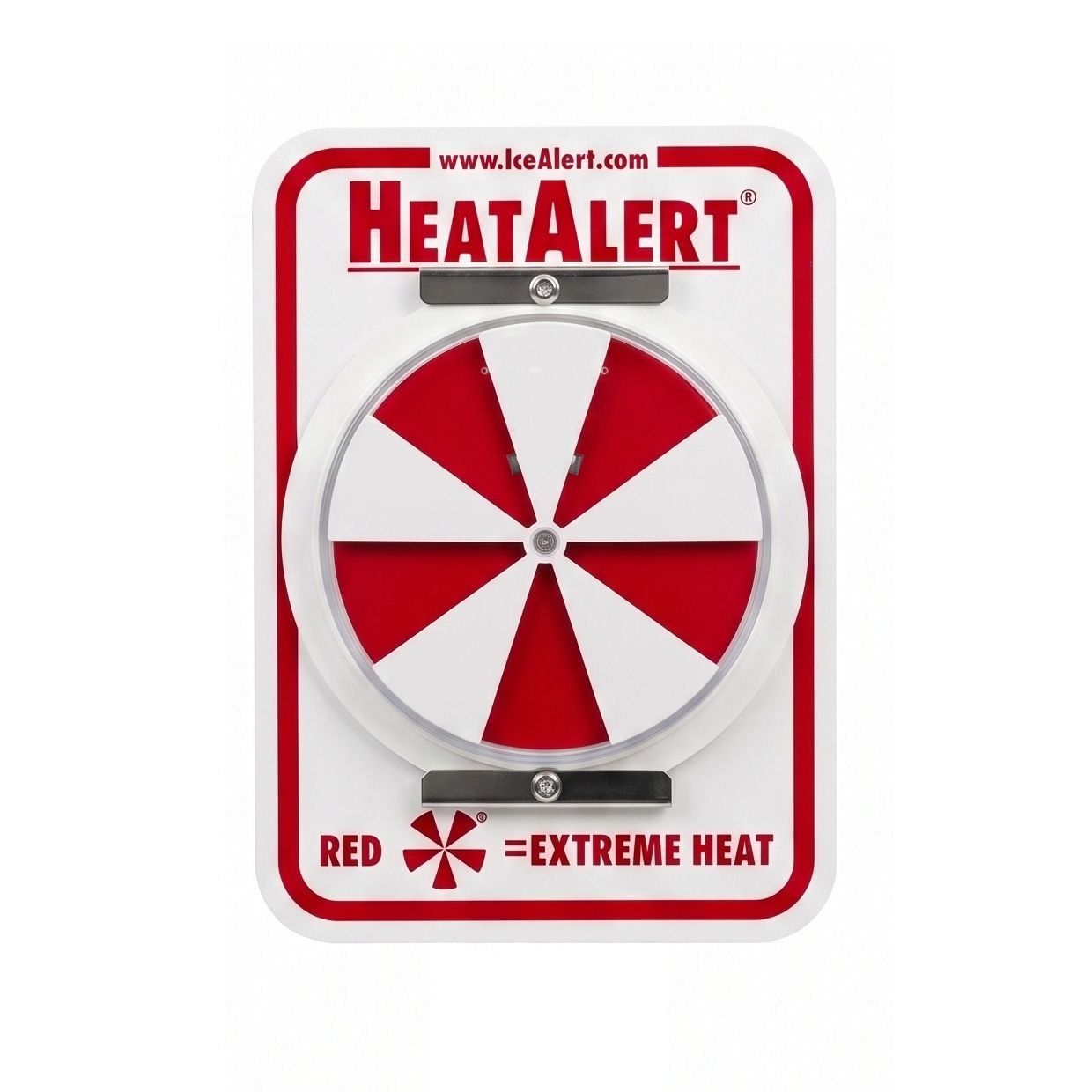
Fast shipping. Wonderful customer service. Keeps our employees safe around the facility. A really great solution- especially when a random 2nd and 3rd “winter” hits.
Safety Officer - Online Review
Making heat, simply visible.
$189 per sign. Maintence-free. Limited quantities available.
Heat Illness Mitigation Policy Guideline
Since OSHA has begun to recognize the importance of protecting workers from heat illnesses, your company may need to develop a Heat Illness Mitigation Policy to comply with OSHA’s standards. To assist you, we have created a free report to help you understand what is needed, and how to create a standard operating procedure (SOP) to protect your workers from excessive workplace heat.
Download your FREE Heat Illness Mitigation Policy Guideline
By filling in your email address, you agree to receive emails from us.